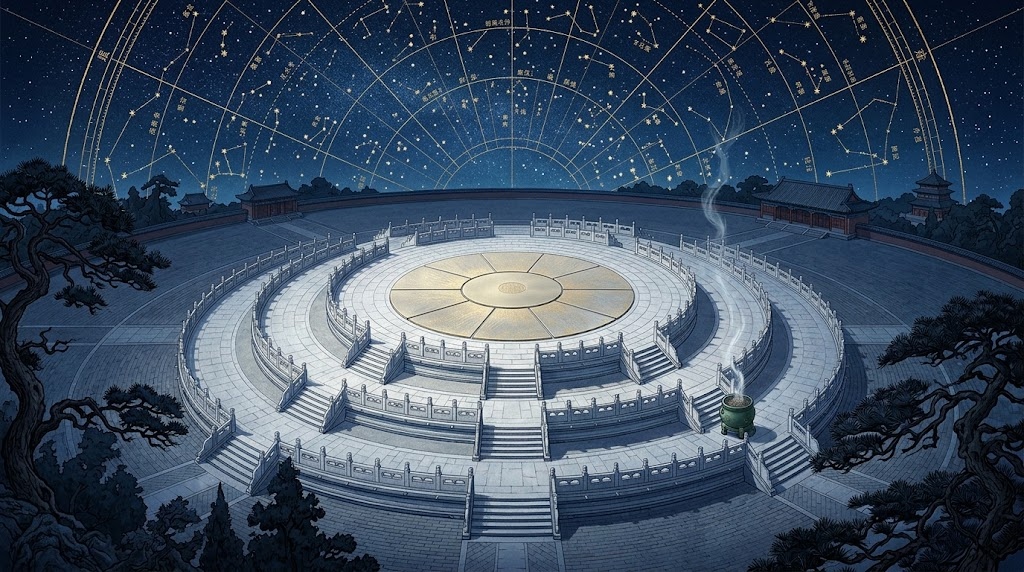
You're looking at a calendar you can walk into.
Count the columns: four in the center for the seasons, twelve for the months, twelve for the hours of the day — twenty-eight in all, one for every constellation in the Chinese sky.
This hall stands thirty-eight meters tall — three tiers of blue roofs, the color of heaven itself — and not a single nail holds it together. Only wood, fitted to wood, balanced like a puzzle that has survived six centuries.
Every year, in the first weeks of the lunar new year, the emperor — the Son of Heaven — came here to ask the sky for one thing: a good harvest for a hundred million people.
You've now walked heaven's axis — from the altar of nines, past the whispering wall, to this stone calendar. Quest complete — keep these cards. Beijing has more axes to walk.
Why is the hall round?
Heaven was round and Earth was square — that was the cosmic rule in imperial China. Almost everything here that touches heaven is circular: the hall, the altar, even the park's northern wall curves while the southern one is square.
Why is the roof blue?
Blue glazed tiles reflect the color of the sky. Fun detail: when the hall was first rebuilt in 1545, its three eaves were blue, yellow, and green — heaven, emperor, and people. Emperor Qianlong later unified them all to blue, because here, heaven outranks everyone.
Seriously — no nails?
None in the main structure. The entire hall is carried by interlocking wooden brackets called dougong and 28 massive timber columns, fitted with mortise-and-tenon joints. It's engineering as sculpture.
What exactly did the emperor do here?
He prayed for grain — the Qigu ceremony, "praying for a good harvest," held in the first lunar month. The big animal sacrifices happened elsewhere, at the Circular Mound Altar (Stop 1). This hall was for prayer, not sacrifice.
What's the deal with the 28 columns?
They're a clock and a star map: 4 central "dragon well" columns for the seasons, 12 for the months, 12 for the traditional double-hours — 28 total, matching the 28 lunar constellations. Medieval Beijing's calendar, built in wood.
How old is it?
The first hall on this spot rose in 1420 — before Columbus sailed. It took its circular form in 1545, burned after a lightning strike in 1889, and was rebuilt within a decade. So the soul is 600 years old; the timber you see is a younger resurrection.
Can I go inside?
The interior is viewed from the doorway and terrace — look up for the gilded dragon-and-phoenix caisson ceiling. Arrive early for a doorway photo without the crowds.
How big is the whole park?
About 2.7 million square meters — nearly four times the Forbidden City. Emperors needed room to feel small before heaven.
Is this place still religious?
The ceremonies ended in 1914; the park opened to the public in 1918. Today it's heritage, not an active temple — the only rituals now are morning tai chi under the cypresses.
Best photo spot?
From Qinian Gate — the last gate before the hall — the hall is perfectly framed by the doorway. Morning light hits the blue roof from the east — arrive before 9 a.m.