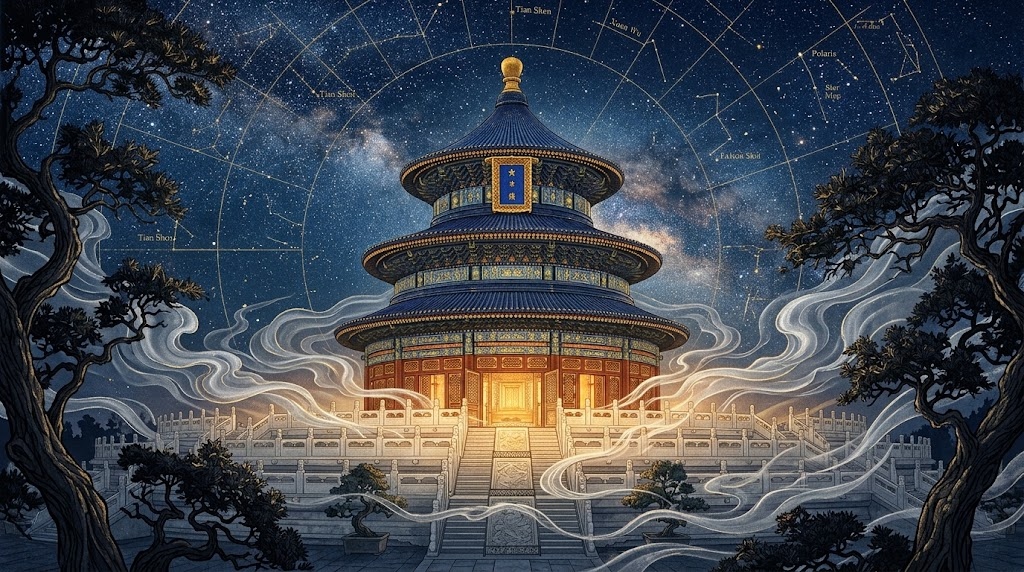
Nine. Remember that number — it's the password of this place.
You're standing on three open-air marble terraces, and everything here comes in nines: nine rings of paving stones fan out from the center — nine, eighteen, twenty-seven, all the way to eighty-one. The stairways climb in nines. Even the balusters count by nines. In the Chinese cosmos, nine was the supreme number of heaven and of emperors.
Once a year, in the cold dark before a winter dawn, the emperor climbed these steps on the winter solstice — the day the sun begins its return. No roof above him: nothing between the Son of Heaven and heaven itself.
Stand on the round stone at the very center — the Heart of Heaven — and speak. Your own voice rolls back at you, deeper, fuller. The emperor heard it too, and believed the sky was listening.
When you're ready, walk north through the Lingxing Gates toward a wall that can whisper. Stop 2 is waiting.
Why is everything in nines?
In imperial numerology, nine was the greatest yang number — pure heaven, pure emperor. The center stone is ringed by 9 rings of slabs: 9, 18, 27 … 81 in the outermost ring. Stairs, balusters, terrace counts — all speak nine.
What is the "Heart of Heaven" stone?
The single round flagstone at the exact center of the top terrace. Stand on it and speak — reflections from the surrounding balustrades bounce back to you almost simultaneously, so your voice sounds strangely amplified, as if the sky is returning your call.
What happened here on the winter solstice?
The year's most important ceremony. The emperor fasted for three days in the Palace of Abstinence, then, before dawn, climbed the altar: prayers, ritual music, dancers — and a sacrificial calf burned in the green-glazed stove so its smoke could rise to heaven.
Why is there no building?
That's the whole point. For this one ritual, nothing was allowed between the emperor and the sky — no roof, no walls, just three open terraces and the universe.
Is this like Stonehenge?
A fun parallel: both are stone monuments to the solstice. Stonehenge aligns with it; here the ritual was performed on it — the day the light begins to return, which is exactly when an empire wants heaven's attention.
Was it always white marble?
No — the 1530 original was faced with blue glazed bricks; Emperor Qianlong rebuilt it in white marble in 1749, giving it today's luminous look.
Why three tiers?
Read it as the cosmos in cross-section — a common interpretation links the three levels to heaven, earth, and humanity, with the emperor standing where all three meet.
Can anyone stand on the center stone?
Yes — join the short queue. Clap once, say your name, listen to what comes back. It's the most photographed sound in Beijing.
When did the ceremonies stop?
The last grand solstice ceremony was held in 1914. Four years later the whole complex became a public park — heaven's altar, now everyone's.
Anything else to see nearby?
Don't miss the Palace of Abstinence (where the emperor fasted) and the Divine Music Office (where ceremonial musicians rehearsed) — both are in the park and usually blissfully uncrowded.